
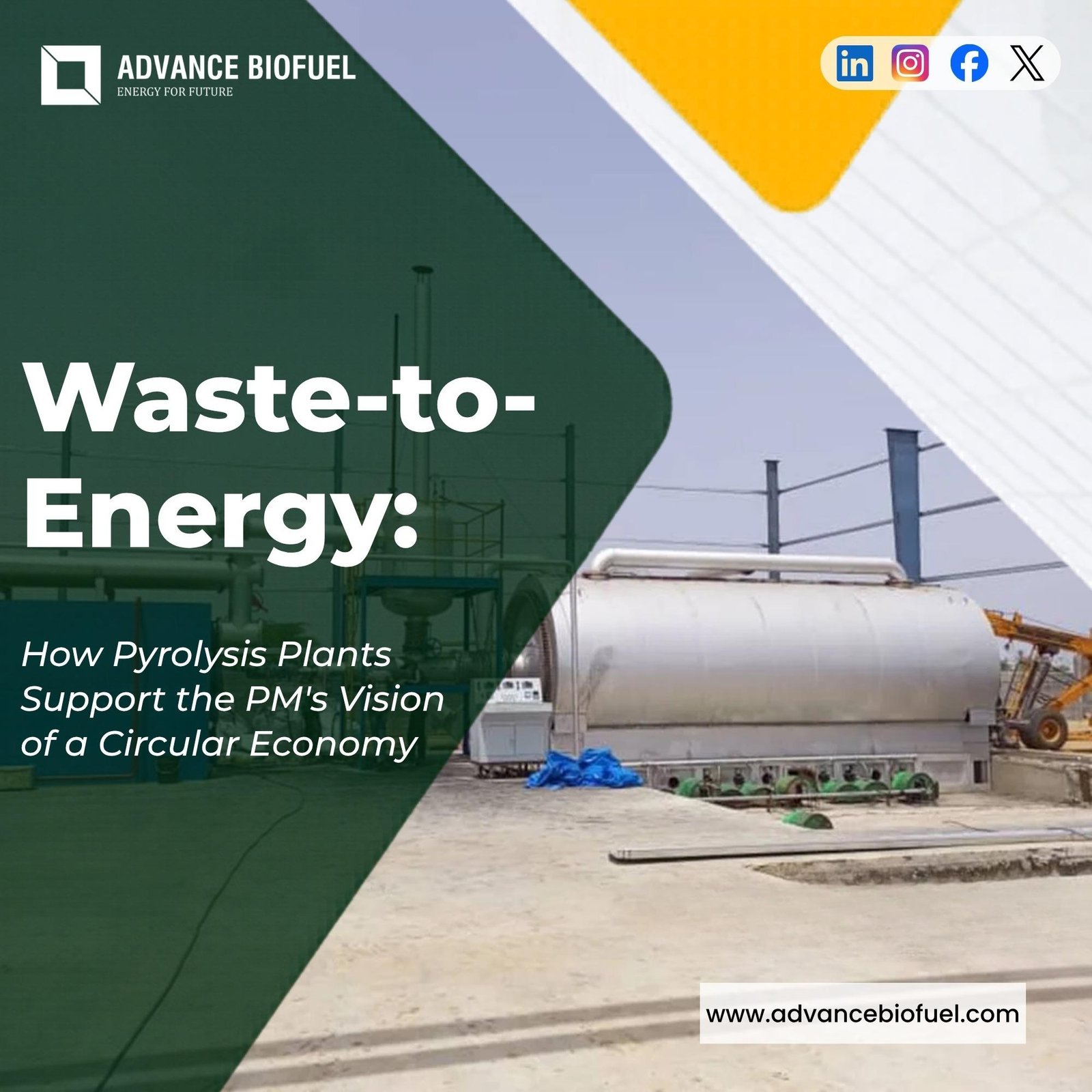
Imagine: A half-kilometre stretch of highway near Delhi where discarded truck tyres sit baking in the sun. A coastal district in Maharashtra where plastic bags choke the canals. A Punjab field where a mountain of agricultural waste smoulders because there is nowhere else for it to go.
Now Imagine the same materials – not rotting, burning, or polluting – but feeding into a sealed industrial reactor, where heat without oxygen quietly strips them down into fuel oil, carbon black, and syngas. What was a crisis at the roadside becomes commerce inside the plant.
That is not a fantasy. That is pyrolysis. And it sits at the beating heart of what Prime Minister Narendra Modi has been building toward for over a decade: an India where waste is not the end of the story – it is the raw material for the next one.
India Has Two Crises. One Technology Solves Both
India currently generates about 62 million tonnes of municipal solid waste annually, and the numbers are accelerating. The country is set to generate 165 million tonnes of waste by 2030 and over 436 million tonnes by 2050 – a trajectory that makes the current waste management challenge look manageable by comparison. [1]
Zoom into the specifics and the picture gets sharper. India produces approximately 26,000 tonnes of plastic waste every single day. [2] A 2024 study found that India recycles only 8% of its plastic waste – and if current patterns continue, that figure will only creep up to 11% by 2035, even as plastic use is expected to nearly quintuple by 2060. [3]
On tyres: India is the world’s third-largest producer and consumer of tyres, generating approximately 1.5 to 2 million tonnes of waste tyres annually. Much of this is still managed by the informal sector through open burning or substandard processes that release toxic fumes and contribute nothing of economic value. [4]
Meanwhile – and this is where the second crisis enters – India’s oil import dependence has climbed to 88.6% of total oil consumption, with petroleum imports estimated at over ₹15 trillion in financial year 2025. [5] [6] The country is simultaneously drowning in hydrocarbon-rich waste and paying a fortune to import hydrocarbons from abroad.
This is the contradiction that pyrolysis directly resolves. And it is exactly the kind of solution that the government’s policy architecture has been quietly clearing the way for.
What the PM Has Actually Built - Beyond the Slogans
When PM Modi launched the Swachh Bharat Mission in 2014, most people saw a cleanliness campaign. What it actually was – in its larger design – was the beginning of a circular economy framework.
Under PM Modi’s leadership, India has accelerated its transition from a linear “take–make–dispose” model to a circular economy that emphasises reuse, recycling, and resource efficiency. [7] The policy architecture is real and it is detailed. The Solid Waste Management Rules 2016, the Plastic Waste Management Rules 2022 (with its sweeping Extended Producer Responsibility mandates), and the Swachh Bharat Mission 2.0 – which set the target of making all cities ‘Garbage Free’ by 2026 – together create a framework that makes doing nothing increasingly expensive.
The PM’s Science, Technology and Innovation Advisory Council (PM-STIAC) has gone further, establishing the Waste to Wealth Mission, which is explicit: waste is a resource, not a burden. This mission specifically includes pyrolysis and gasification units as preferred technologies for converting solid waste into energy – giving the technology formal government backing at the highest advisory level. [8]
With effective implementation of circular economy practices across sectors, India could lower its greenhouse gas emissions by 45% by 2030. India’s adoption of a circular economy is also estimated to generate USD 624 billion in benefits annually by 2050. [9] The business case for getting on the right side of this transition is not abstract – it is enormous.
Pyrolysis, Plainly Explained
Here is what happens inside a pyrolysis plant, without the jargon.
Organic materials – plastic waste, used tyres, rubber scraps, biomass – are fed into a sealed reactor. The reactor heats the material to temperatures between 300°C and 700°C in a completely oxygen-free environment. Without oxygen, the material cannot combust. Instead, it decomposes – breaking apart at a molecular level into its constituent compounds.
What comes out is not ash and smoke. What comes out is:
Pyrolysis Fuel Oil (PFO): The primary output, typically yielding 40–60% of input weight. This oil can directly replace furnace oil and heavy diesel in industrial boilers, generators, and marine applications. With further refining through a distillation plant, it can be upgraded to diesel-grade fuel.
Recovered Carbon Black (rCB): Accounting for roughly 25–35% of output, carbon black is a commercially valuable material used in tyre manufacturing, rubber compounding, pigments, and construction. India’s domestic carbon black market is growing rapidly and increasingly receptive to recovered sources. [10]
Syngas: The gaseous fraction – about 10–15% of output – is typically recirculated back into the reactor to heat it, making the plant near-energy-self-sufficient during steady-state operations and cutting external fuel costs by 40–60%.
Steel Wire (from tyres): When waste tyres are processed, the embedded steel wires are recovered intact and sold as scrap metal – an additional revenue stream that costs nothing extra to produce.
The critical distinction that often gets lost in public perception: pyrolysis is not incineration. There is no open flame, no combustion, and no stack of toxic smoke. It is a controlled, enclosed thermochemical process – and when operated to proper standards, it is one of the cleanest ways to deal with plastic and rubber waste that currently has no other effective end-of-life pathway. [11]
The Regulatory Window Is Open - But It Won't Stay Wide
Here is the compliance dimension that every plastic recycler, tyre dealer, and industrial waste generator in India needs to understand right now.
Under the Plastic Waste Management (Amendment) Rules 2022, more than 51,000 producers, importers, and brand owners are now registered under India’s EPR framework. Since February 2022, over 157 lakh tonnes of plastic packaging waste have been recycled. [12] The EPR certificates generated by registered plastic waste processors reached 2.5 million tonnes for 2022–23 – but the total EPR obligation of registered producers was 3 million tonnes. [13] That gap is a compliance liability that is growing, not shrinking.
On tyres, the Extended Producer Responsibility Regulations for Waste Tyres, introduced in 2022, are now mandatory and enforceable. Tyre producers and importers must meet annual recycling targets by purchasing EPR Credits from registered recyclers via a CPCB digital portal. [14] Since 2024–25, the target has reached 100% – meaning 100% of the tyres a manufacturer placed in the market two years ago must be formally recycled, no exceptions. [15]
NITI Aayog convened a national conference – Paryavaran NITI Manthan – in May 2026 to overhaul India’s waste tyre management system. The conference proposed national standards for Tyre Pyrolysis Oil and recovered Carbon Black, separate HSN codes, and GST rationalisation – moves that will formalise and legitimise high-quality pyrolysis output as a commercial commodity. [16]
The message could not be clearer: companies that build certified, compliant pyrolysis capacity today are not just managing waste. They are generating EPR credits, selling compliance infrastructure to brands who desperately need it, and positioning themselves as integral nodes in an increasingly regulated national supply chain.
Who Should Be Looking at a Pyrolysis Plant?
The conversation around pyrolysis tends to stay in industrial circles when it belongs in boardrooms across several sectors. Here is who the economics actually make sense for:
Plastic waste recyclers – Already collecting the feedstock. Pyrolysis adds a monetisation layer that mechanical recycling alone cannot match for mixed or contaminated plastic streams that have no other buyers.
Tyre dealers and retreaders – End-of-life tyres are piling up and EPR obligations are legally enforceable. A certified pyrolysis unit converts your compliance cost into a revenue stream.
Municipal corporations and waste management firms – Landfill space is finite, diversion targets are real, and waste-to-energy is increasingly the answer municipalities are expected to demonstrate.
Industrial estates and SEZs – Captive fuel production using on-site waste cuts the energy bill while demonstrating the ESG commitment that large corporate tenants increasingly demand.
Green entrepreneurs and investors – India’s waste management market, valued at USD 22.17 billion in 2023, is projected to reach USD 54.20 billion by 2030 at a CAGR of 12.5%. [17] Pyrolysis sits at the most underserved and high-growth end of that market.
What Separates a Good Pyrolysis Plant from a Problematic One
This is a critical conversation because India’s pyrolysis sector has suffered reputationally from the proliferation of informal, uncontrolled units that process tyres with no emission control, no output quality, and no regulatory compliance. CPCB issued a revised Standard Operating Procedure in January 2024 specifically to push the industry toward continuous, automated pyrolysis systems with mandatory emission monitoring. [18]
The difference between a plant that degrades the sector and one that advances it comes down to several non-negotiable factors:
Multi-feedstock capability means not being operationally stranded if one waste stream dries up or its economics shift. A plant that processes plastic, tyres, rubber, and biomass can adapt as markets move.
Integrated emission control systems, compliant with CPCB norms and international standards, are not optional – they are what separates a legal, profitable operation from one that faces NGT action and shutdown notices.
PLC automation ensures process precision, consistent output quality, and the kind of data trail that regulators and downstream buyers increasingly require.
ISO 9001:2015 and CE certification are the benchmarks that matter when supplying fuel oil to industrial buyers or recovered carbon black to tyre OEMs who will verify quality credentials before any purchase order is signed.
12–24 month ROI is achievable for a well-designed, properly fed plant – but only if the design, feedstock sourcing, and output marketing are planned as an integrated system from the start.
At Advance Biofuel, we have built and commissioned 500+ plants across 40+ countries – and our Pyrolysis Plant offering is designed with exactly these requirements in mind. Turnkey delivery means we carry the project from concept and engineering to installation, commissioning, and after-sales support. One partner, full accountability, zero handoff gaps.
For operators who want to extract maximum value from pyrolysis oil, our Pyrolysis Distillation Plant is the logical next step – upgrading raw PFO into diesel-grade fuel that commands a premium in the industrial and refining market.
The Bigger Picture: India's Circular Economy Needs Plants, Not Just Policy
PM Modi stood before global leaders at the 12th Regional 3R and Circular Economy Forum in Jaipur in 2025 and offered to share India’s learnings in its journey toward a circular economy – highlighting initiatives in bio-CNG, plastic waste management, and e-waste recycling, reaffirming the government’s commitment to a low-carbon, resource-efficient society. [19]
The Jaipur Declaration (2025–2034) was adopted at that forum – a framework to guide the next decade’s efforts toward resource efficiency and sustainable urban development across the Asia-Pacific region. [20]
India is not short of vision. India is not short of policy. What India genuinely needs more of – to close the gap between a declared circular economy and a functioning one – is industrial infrastructure. Plants that take the waste streams that policies have correctly identified as valuable, and actually convert them into fuel, carbon, and energy at commercial scale.
Circular economies are not built by declarations. They are built by plants.
Conclusion: The Mountain of Waste Is Waiting
Every day that a tyre sits in an open field or a plastic bale goes uncollected is a day that oil worth thousands of rupees is left on the ground.
India generates enormous quantities of hydrocarbon-rich waste. India imports enormous quantities of hydrocarbons. The solution connecting these two facts is not a mystery – it is a pyrolysis plant, properly designed, properly certified, and properly operated.
The companies that build this capacity now – while EPR incentives are live, regulatory frameworks are being formalised, and feedstock supply chains are maturing – will be the ones that define India’s waste-to-energy landscape for the next twenty years.
The ones that wait will find feedstocks more expensive, compliance obligations steeper, and market positions already occupied.
Ready to evaluate a pyrolysis plant for your business or municipality? Talk to the Advance Biofuel team for a free project feasibility consultation.
References
[1] “Waste to Wealth Mission.” Invest India, Government of India, Prime Minister’s Science, Technology and Innovation Advisory Council (PM-STIAC).
https://www.investindia.gov.in/waste-to-wealth
[2] “India Generates 26,000 Tonnes of Plastic Waste Every Day.” CSIRO – Commonwealth Scientific and Industrial Research Organisation, Australia–India Comprehensive Strategic Partnership, December 2023.
https://www.csiro.au/en/news/All/Articles/2023/December/Circular-Economy-Roadmap-India
[3] “India Recycles Only 8 Percent of Its Plastic Waste, Reveals Study.” The Week, February 5, 2024.
https://www.theweek.in/news/india/2024/02/05/india-recycles-only-8-percent-of-its-plastic-waste-says-study.html
[4] “Enhancing Circular Economy of Waste Tyres in India.” NITI Aayog, Government of India, January 2026.
https://niti.gov.in/sites/default/files/2026-01/Enhancing-Circular-Economy-of-Waste-Tyres-in-India.pdf
[5] “India’s Oil Import Dependence Climbs to Nearly 89% as Domestic Output Lags.” OilPrice.com, February 24, 2026.
https://oilprice.com/Latest-Energy-News/World-News/Indias-Oil-Import-Dependence-Climbs-to-Nearly-89-as-Domestic-Output-Lags.html
[6] Reserve Bank of India. “Value of Petroleum Products Imported into India from Financial Year 2011 to 2025 (in billion Indian rupees).” Statista, September 1, 2025.
https://www.statista.com/statistics/625218/import-value-of-petroleum-india/
[7] “Explore New Avenues in India’s Circular Economy.” MyGov Blogs, Ministry of Electronics and Information Technology, Government of India.
https://blog.mygov.in/editorial/explore-new-avenues-in-indias-circular-economy/
[8] “Waste to Wealth Mission: Technology Park and Pyrolysis Units.” Invest India, Government of India, PM-STIAC Framework.
https://www.investindia.gov.in/waste-to-wealth
[9] Arora, M. et al. “India’s Transition to a Circular Economy Towards Fulfilling Agenda 2030: A Critical Review.” Sustainability, MDPI, Vol. 17, Issue 6, Article 2667, March 18, 2025. DOI:
https://doi.org/10.3390/su17062667
[10] “Reimagining Tyre Waste Management in the Circular Economy.” Autocar Professional, August 16, 2024.
https://www.autocarpro.in/news/-reimagining-tyre-waste-management-in-the-circular-economy-122053
[11] “Regulatory Loopholes: India’s Waste Tyre Management Crisis Unveiled.” Down to Earth, November 3, 2025.
https://www.downtoearth.org.in/environment/regulatory-punctures-stalling-waste-tyre-management-in-india
[12] “Explore New Avenues in India’s Circular Economy – EPR Framework Statistics.” MyGov Blogs, Government of India.
https://blog.mygov.in/editorial/explore-new-avenues-in-indias-circular-economy/
[13] “Generation of Plastic Waste – EPR Obligations and Certificates.” Press Information Bureau (PIB), Ministry of Environment, Forest and Climate Change, Government of India.
https://www.pib.gov.in/PressReleasePage.aspx?PRID=1943210
[14] “India Pushes Circular Economy for End-of-Life Tires Under NITI Aayog Roadmap.” Weibold – Tire Recycling & Pyrolysis Consulting, 2026.
https://weibold.com/india-pushes-circular-economy-for-end-of-life-tires-under-niti-aayog-roadmap
[15] “Waste Tyre EPR Portal – Register with CPCB for Legal and Environmental Benefits.” EPR Tyres CPCB, Central Pollution Control Board, Government of India.
https://www.eprtyrescpcb.in
[16] “Waste Tyre Management Overhaul: NITI Aayog Proposes New Standards for Tyre Pyrolysis Oil and Recovered Carbon Black.” Down to Earth, May 7, 2026.
https://www.downtoearth.org.in/waste/waste-tyre-management-overhaul-niti-aayog-proposes-new-standards-for-tyre-pyrolysis-oil-and-recovered-carbon-black
[17] “India Plastic Recycling Market Size, Trends, Share 2033.” Custom Market Insights, April 2026.
https://www.custommarketinsights.com/report/india-plastic-recycling-market/
[18] “CPCB Issues New SOP for Pyrolysis Plants – Advanced Batch Automated Pyrolysis (ABAP), January 2024.” Central Pollution Control Board (CPCB), Ministry of Environment, Forest and Climate Change, Government of India. Referenced in: “Regulatory Loopholes: India’s Waste Tyre Management Crisis Unveiled.” Down to Earth, November 3, 2025.
https://www.downtoearth.org.in/environment/regulatory-punctures-stalling-waste-tyre-management-in-india
[19] “India Willing to Share Learnings in Its Journey Towards a Circular Economy: PM Modi.” DD News, Doordarshan National, Government of India, 2025.
https://ddnews.gov.in/en/india-willing-to-share-learnings-in-its-journey-towards-a-circular-economy-pm-modi/
[20] “India’s Leadership in Circular Economy: A Pathway to Viksit Bharat – Jaipur Declaration 2025–2034.” Dr. Syama Prasad Mookerjee Research Foundation, April 3, 2025.
https://spmrf.org/indias-leadership-in-circular-economy-a-pathway-to-viksit-bharat/

