
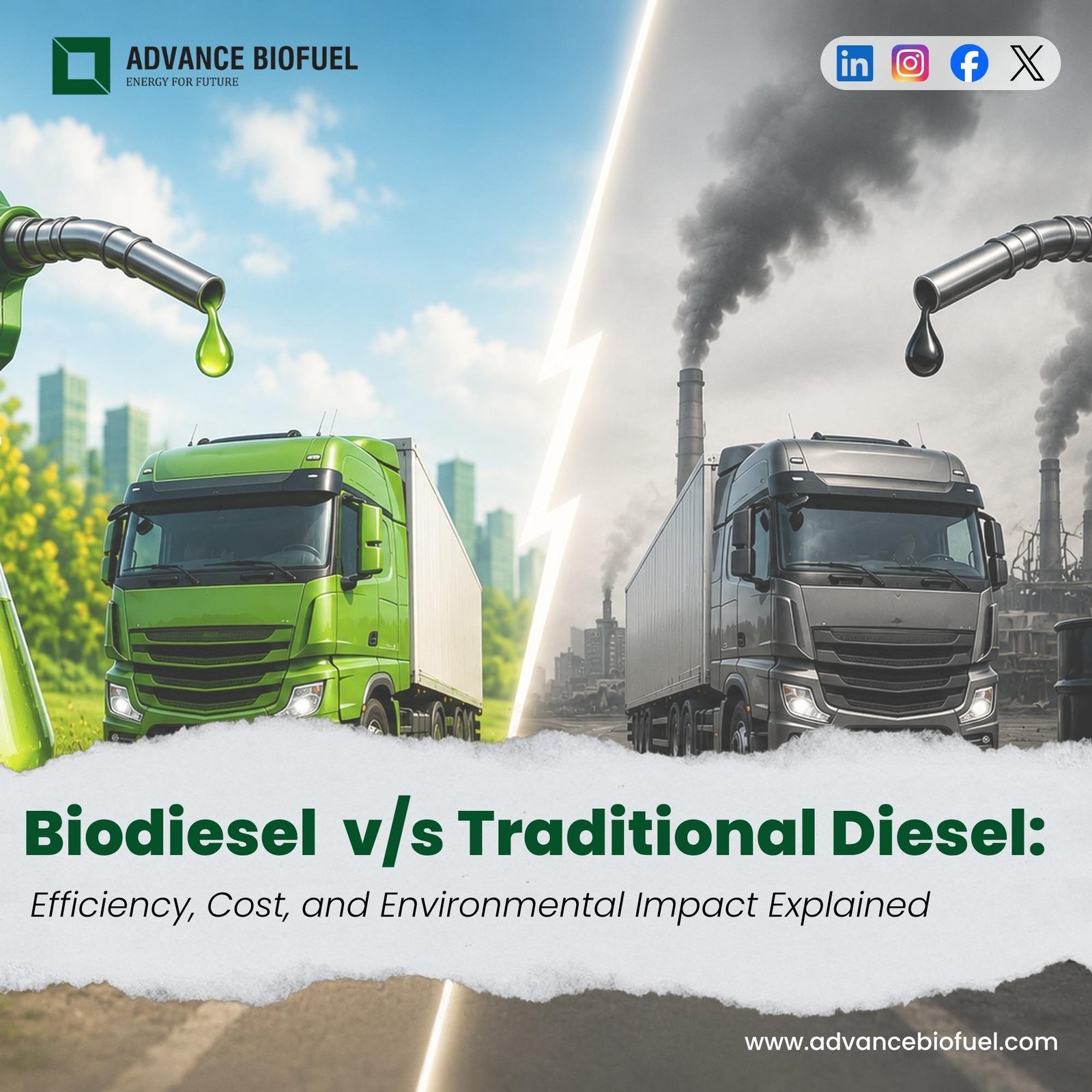
Picture this: a truck fleet owner sitting at his desk in Pune, staring at his diesel bill for March 2026. Crude prices have been surging since the Middle East conflict intensified. His monthly fuel costs have jumped by nearly 30% compared to the same period last year. His business is still profitable – but barely.
He’s heard about biodiesel. A friend who runs a transport company in Rajasthan swears by it. But the questions swirl: Is it as powerful as regular diesel? Will it damage my engines? And is it actually cheaper – or just greener marketing?
If you’ve ever asked similar questions, you’re in exactly the right place. This is a no-fluff, data-backed breakdown of biodiesel versus traditional petroleum diesel – covering efficiency, cost, environmental impact, and what it all means for businesses and investors in India today.
What Are We Actually Comparing?
Before we get into the numbers, let’s make sure we’re comparing apples to apples.
Traditional petroleum diesel is refined from crude oil through a process called fractional distillation. It has powered the vast majority of India’s commercial vehicles, tractors, buses, and industrial machinery for decades. The problem? Every drop of it depends on imported crude oil – and India’s oil import dependency stood at approximately 88.3% in FY2025, leaving the country exposed to every OPEC decision and geopolitical crisis that ripples through global energy markets. [1]
Biodiesel, on the other hand, is a domestically produced, renewable fuel made through a chemical process called transesterification – where vegetable oils, animal fats, or used cooking oil (UCO) react with methanol in the presence of a catalyst like sodium hydroxide. The result is a clean-burning fuel called FAME (Fatty Acid Methyl Esters), which can be blended with petroleum diesel in ratios of B5, B10, B20, or used in its pure B100 form. [2] In India, the primary feedstocks are UCO collected from restaurants and hotels, Jatropha, Karanja (Pongamia), palm acid oil, and animal tallow – all locally available, largely wasted resources that biodiesel turns into fuel.
Same job. Different origin story. Very different implications.
Round 1 - Efficiency: Does Biodiesel Keep Up?
This is where most conversations go wrong, because people focus on one number and miss the full picture.
Energy density – biodiesel’s only real weakness: Biodiesel has approximately 10–12% lower energy content per litre compared to petroleum diesel. At B100 (pure biodiesel), a vehicle may see a modest drop in fuel economy. That’s a real trade-off, and it’s worth being honest about. [3]
But here’s the critical nuance: at B20 (the 20% blend that India is actively promoting), the fuel economy difference is less than 2% – practically invisible in day-to-day fleet operations. The Government of India’s own inter-ministerial roadmap data confirms no major vehicle performance issues at B20 levels. [4] A truck driver is unlikely to notice any difference at all.
Now, where does biodiesel genuinely outperform diesel?
Cetane number – the real measure of ignition quality: The cetane number measures how quickly a fuel ignites under compression – the higher, the better. Petroleum diesel typically scores between 48–52. Biodiesel scores between 56–58, sometimes higher depending on feedstock. [5] A higher cetane number means smoother, more complete combustion: less engine knock, quicker cold starts, and quieter operation. The engine works less hard to do the same job.
Lubricity – protecting your engine from the inside: Here’s something many fleet operators don’t know: modern ultra-low sulphur petroleum diesel is actually worse for engine wear than older diesel, because removing sulphur also strips away natural lubricity. Biodiesel is naturally lubricating. Its better lubricity reduces wear on fuel pumps and injectors, which are expensive to replace. [6] Fleets running B20 often report longer intervals between fuel system maintenance – a real, measurable cost saving that doesn’t show up in the per-litre price comparison.
Cold weather behaviour: B100 can gel at temperatures below 10°C, which is a legitimate concern in colder climates. However, B20 blends handle India’s climate conditions across all regions without any gelling issues – from the plains of Bihar to the highways of Tamil Nadu.
Efficiency verdict: At B20, biodiesel is essentially a performance-equal, often performance-superior fuel. The only meaningful trade-off (minor fuel economy at B100) disappears at the blend levels that Indian policy actually targets.
Round 2 - Cost: Which Fuel Is Cheaper for Indian Businesses?
The cost picture is more nuanced than a simple per-litre comparison – and it tilts firmly in biodiesel’s favour once you look at the full picture.
The raw price: India’s retail diesel price fluctuated around ₹87–92 per litre in 2025-26, driven by global crude volatility. OMC (Oil Marketing Companies) procurement prices for biodiesel under their tender programmes were set at ₹91.20 per litre for October 2024–January 2025 and ₹100.12 per litre for February–September 2025 (excluding GST and transport). [7] These are the prices OMCs are willing to buy biodiesel at – suggesting the market rate is competitive with conventional diesel.
For businesses that produce their own biodiesel from UCO, production costs can come in significantly lower – particularly at scale – which is where the margin opportunity lies for entrepreneurs entering the biodiesel sector.
The hidden cost advantages that don’t appear in price per litre:
Import price volatility: Petroleum diesel prices move with every OPEC decision, every Middle East flare-up, every dollar-rupee fluctuation. Biodiesel produced from domestic feedstocks is largely insulated from this rollercoaster. In a year where crude touched $113 per barrel, that insulation is worth more than any per-litre discount.
Lower maintenance bills: Better lubricity means fewer injector and fuel pump replacements. For a fleet running 50 trucks, this is a meaningful annual saving.
Government-backed demand: Oil Marketing Companies are mandated to purchase biodiesel under India’s National Biofuel Policy 2018. OMC biodiesel procurement hit a record 489.3 million litres in 2024, more than double the volumes from a few years prior. [8] This guaranteed offtake mechanism means biodiesel producers face less market risk than most industries.
By-product revenue: Biodiesel production generates glycerol as a by-product – a valuable commodity used in pharmaceuticals, cosmetics, and food processing. A well-run plant sells its glycerol rather than treating it as waste, meaningfully improving overall unit economics.
For investors – the supply gap opportunity: India’s biodiesel blending ratio stood at just 0.5% in 2024 against a target of 5% by 2030. [9] Reaching that target requires a production capacity of 5.50 billion litres per annum – with the current supply gap estimated at 4.95 billion litres. [10] That’s not a small number. That’s a decade-long business opportunity hiding in plain sight.
Advance Biofuel’s own CAPEX and ROI analysis shows that medium-to-large biodiesel plants (20–30+ TPD) can achieve return on investment in 3–5 years when operating with firm offtake agreements and efficient feedstock sourcing. [11]
Cost verdict: At scale and with proper feedstock management, biodiesel is cost-competitive – and often cheaper – than petroleum diesel. The economics are further strengthened by India’s blending mandates, guaranteed OMC demand, and the ongoing volatility of global crude prices.
Round 3 - Environmental Impact: This Is Where Biodiesel Wins Decisively
No other part of this comparison is cleaner. The environmental case for biodiesel is overwhelming, and the data from peer-reviewed science and major energy agencies says the same thing.
Carbon dioxide – the lifecycle story: Here’s why lifecycle analysis matters: when biodiesel burns, it releases CO₂ – but that CO₂ was already absorbed from the atmosphere by the plants or organic materials used to make the fuel. It’s part of the biogenic cycle, not new carbon being extracted from underground and released for the first time. According to Argonne National Laboratory’s GREET model, switching from conventional diesel to B100 biodiesel cuts lifecycle CO₂ emissions by approximately 74–75%. [12] When biodiesel is produced from used cooking oil – the feedstock India’s RUCO initiative is actively promoting – that figure improves even further, with some studies showing lifecycle CO₂ reductions of over 90% compared to petroleum diesel. [13]
At B20, even partial blending delivers proportional benefits. Every tanker truck running B20 on India’s highways is cutting its carbon footprint by roughly 15% – with no engine modifications required.
Particulate matter and carbon monoxide: The EPA’s data, widely cited in energy research, shows that biodiesel reduces carbon monoxide (CO) emissions by approximately 11% and particulate matter (PM) by around 10% compared to petroleum diesel. [14] In Indian cities where PM2.5 levels already breach safe limits for months at a stretch, this is not a technical footnote – it’s a public health argument.
Sulphur emissions: Petroleum diesel contains 10–50 ppm of sulphur, which burns to produce sulphur oxides (SOx) – a major driver of acid rain and respiratory disease. Biodiesel contains near-zero sulphur. [15] Every litre of biodiesel blended into India’s diesel pool reduces this problem.
The NOx caveat – worth mentioning honestly: Biodiesel can produce slightly elevated nitrogen oxide (NOx) emissions – approximately 10% higher than petroleum diesel – due to its higher combustion temperature. [16] This is the one genuine air quality trade-off. However, modern engine exhaust control technologies, including Selective Catalytic Reduction (SCR) systems, effectively neutralise this issue in BS-VI compliant engines, which now cover the bulk of India’s new vehicle fleet.
Biodegradability: Unlike petroleum diesel, which persists in soil and groundwater for extended periods, biodiesel is highly biodegradable – breaking down far more rapidly when spilled. For operations in ecologically sensitive areas – agriculture, mining, riverine transport – this distinction matters.
Environmental verdict: Biodiesel wins this round comprehensively. A 74% lifecycle CO₂ reduction, near-zero sulphur, lower particulate emissions, and high biodegradability combine to make biodiesel one of the most impactful, immediately deployable tools India has for meeting its NDC (Nationally Determined Contribution) targets under the Paris Agreement.
The India Angle: Why This Comparison Is Especially Relevant Right Now
The numbers above don’t exist in a vacuum. They play out against a very specific Indian policy backdrop that makes the biodiesel opportunity more urgent and more commercially attractive than ever before.
India’s National Biofuel Policy 2018 (amended 2022) has set a target of 5% biodiesel blending in diesel by 2030. [17] India’s diesel consumption is projected to reach 104,000 thousand metric tonnes by 2030 – growing at a CAGR of 2.7%. [18] The mathematics of that target creates a straightforward business case: a market that needs 5.50 billion litres of biodiesel annually, with current domestic production covering less than 15% of that requirement.
The RUCO (Repurpose Used Cooking Oil) initiative is building the UCO supply chain. The government has opened direct sale of B100 biodiesel to all consumers since June 2017. [19] OMC procurement contracts provide price certainty and guaranteed offtake. The ingredients of a viable business ecosystem are all in place. What’s missing – and what creates the opportunity – is production capacity.
This is precisely the gap that Advance Biofuel’s turnkey Biodiesel Production Plants are built to fill. From small community-scale plants to full industrial-capacity facilities, with multi-feedstock compatibility, complete turnkey delivery, and after-sales support that stays with you through commissioning and beyond.
The Verdict - Biodiesel Wins on Every Metric That Matters for India's Future
Let’s be direct.
On efficiency – at B20, biodiesel is essentially equivalent to petroleum diesel, with meaningful advantages in ignition quality and engine protection. On cost – at scale, with domestic feedstock and guaranteed OMC offtake, biodiesel competes strongly and buffers operators from global crude volatility. On environment – biodiesel reduces lifecycle CO₂ by up to 74%, nearly eliminates sulphur emissions, cuts PM significantly, and biodegrades faster than petroleum diesel. On energy security – biodiesel is made in India, from Indian waste, creating Indian jobs, and keeping rupees in the domestic economy instead of sending them to oil-exporting nations.
Traditional diesel still runs most of India today. But the direction of travel is irreversible – and the businesses that move early on biodiesel production and blending will capture the most value from that transition.
Thinking about entering India's biodiesel sector - as a producer, investor, or fleet operator? Advance Biofuel has delivered turnkey biodiesel plants across India for over 12 years. Get a free consultation and find out what plant size, feedstock model, and ROI projection makes sense for your situation.
Frequently Asked Questions
Does biodiesel damage diesel engines?
How much cheaper is biodiesel than diesel in India?
What is India's biodiesel blending target?
Can I use biodiesel in my existing truck or bus fleet?
How do I start a biodiesel production business in India?
References & Citations
- Governance Now – India’s Growth Story Still Runs on Imported Oil (2026) – Link
- Legacy IAS – Biofuels & National Biofuel Policy UPSC Notes 2026 – Link
- Oxford Academic / IJLCT – Comparison of Performance and Emissions of Different Biodiesel Blends – Link
- PIB India – Government Measures on Ethanol Blending Beyond 20% – Link
- MB Energy Glossary – Cetane Number – Link
- SC Fuels – Biodiesel vs. Diesel Fuel: How Biodiesel Compares (Feb 2025) – Link
- BW Businessworld – Raw Material, Subsidy Key For 5% Biodiesel Blend By 2030 – Link
- IEA AMF – Advanced Motor Fuels in India – Link
- USDA FAS – Biofuels Annual Report, India (June 2025) – Link
- BW Businessworld – Raw Material, Subsidy Key For 5% Biodiesel Blend By 2030 – Link
- Advance Biofuel – Biodiesel Plant Cost in India 2025–26: CAPEX & ROI – Link
- Grease Connections – Biodiesel vs. Diesel: Full Lifecycle Carbon Analysis (Aug 2025) – Link
- ScienceDirect – Lifecycle Emissions of UCO Biodiesel Blends, Real-World Test (2022) – Link
- Smartreability – Environmental Effects of Biodiesel (April 2026) – Link
- Elan Fuels – Biodiesel vs Diesel: Fuel Efficiency, Trucks & Engines (Nov 2025) – Link
- Baker Institute – What to Know About Renewable Diesel and Biodiesel (Aug 2025) – Link
- IEA AMF – Advanced Motor Fuels in India – Link
- BW Businessworld – Raw Material, Subsidy Key For 5% Biodiesel Blend By 2030 – Link
- Ministry of Petroleum & Natural Gas, Government of India – Biodiesel Policy – Link

